


IS FREETOWN SITTING ON A DISASTER TIME BOMB? BUILDING SAFETY AND NATIONAL PREPAREDNESS UNDER SCRUTINY
By: James Kamara-Manneh
NDMA, geoscientists assess affected buildings as calls grow for stronger emergency plans and public education
Reports of earth tremors across several parts of Freetown on Tuesday, October 13, 2026, have raised concerns about building safety, emergency response and Sierra Leone’s preparedness for earthquakes and other natural disasters.
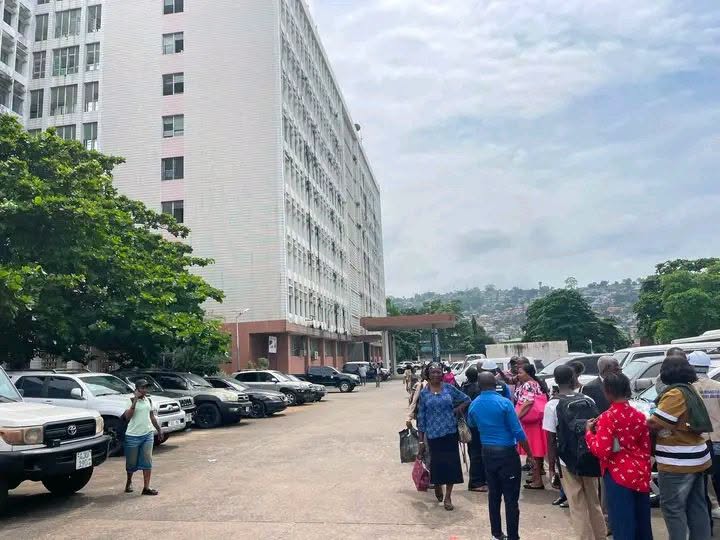
Residents and workers reportedly felt shaking around Youyi Building, parts of central Freetown, Waterloo Street, Wellington Street and other locations. Reports that the eighth and ninth floors of Youyi Building experienced movement also raised questions about the safety of the government facility.
However, the precise cause of the shaking and its connection to offshore earthquakes remain subjects for scientific investigation. The reported movement alone does not establish that any particular building is structurally unsafe.
The National Disaster Management Agency (NDMA), in collaboration with the Sierra Leone Institution of Geoscientists (SLIG) and the Ministry of Works and Public Assets, has launched an investigation into the incident.
The investigation presents an opportunity for Sierra Leone to assess its emergency preparedness and identify practical measures to protect lives if similar incidents occur again.
According to information released by the NDMA, residents reported feeling tremors at approximately 12:30 p.m. on Tuesday. The agency subsequently engaged geoscientists to help determine the possible cause.
Preliminary information from international seismic monitoring organisations indicated significant earthquake activity along the Central Mid-Atlantic Ridge.
The NDMA referred to a magnitude 6.7 earthquake recorded by the United States Geological Survey at 5:44 a.m. GMT, at a depth of approximately 10 kilometres. It also cited a later magnitude 6.8 earthquake reported by the United States National Tsunami Warning Center at approximately 12:23 p.m. GMT.
Although the timing of the later earthquake appeared close to reports of shaking in Freetown, the NDMA said further scientific analysis was necessary to establish whether the events were directly connected.
A Technical Working Group comprising the NDMA, SLIG and the Ministry of Works and Public Assets has been established to investigate the incident.
A joint assessment team visited Africell’s head office in Wilberforce, Youyi Building, a commercial building on Siaka Stevens Street housing the Independent Media Commission and Aureol Insurance Company, and the Ministry of Gender and Children’s Affairs.
The initial assessment found no major structural damage, significant property destruction or fatalities at the inspected locations.
The agency said consultations with national and international experts would continue. Members of the public have been encouraged to report damage, structural concerns and further tremors through the NDMA’s toll-free emergency line, 1199.
An earthquake occurs when energy is suddenly released within the Earth, generating seismic waves that cause ground movement. The resulting shaking can range from barely noticeable vibrations to movements capable of damaging buildings.
A tremor refers to shaking or vibration. It may be associated with an earthquake, although vibrations can also originate from other sources.
Therefore, a tremor is not necessarily a separate event from an earthquake, and the word does not automatically mean that the situation is harmless.
The seriousness of an earthquake depends on its magnitude, depth, distance from populated areas, local ground conditions and the intensity of shaking experienced at a particular location.
High-rise buildings can respond differently to ground movement because of their height, structural design and the characteristics of seismic waves. However, determining why a particular building shook requires scientific measurements and, where necessary, professional structural assessment.
Tuesday’s incident raises an important question: Is Sierra Leone adequately prepared to respond if a major earthquake or another natural disaster occurs?
Although the likelihood of a destructive earthquake may be low in some areas, preparedness remains essential. Sierra Leone faces other hazards, including flooding, fires, landslides and building-related emergencies.
The Ministry of Works and Public Assets and relevant building-control authorities should consider risk-based inspections of high-rise buildings, schools, hospitals, government offices and other facilities accommodating large numbers of people.
Buildings associated with credible reports of damage should receive priority assessment by qualified structural engineers. Where serious damage or an immediate safety risk is identified, access should be restricted until professionals determine whether the structure is safe.
Authorities must also avoid causing unnecessary panic by declaring buildings unsafe without technical evidence. Public safety decisions should be based on engineering findings rather than speculation.
First, educate the public. The NDMA, SLIG and relevant ministries should publish clear emergency instructions through radio, television, social media, schools and community meetings. Information should be available in accessible English and local languages, including Krio.
Second, teach people to DROP, COVER AND HOLD ON. When shaking begins indoors, people should drop to their hands and knees, take cover under a sturdy table or desk, and hold on until the shaking stops. If no cover is available, they should protect their head and neck and stay away from windows and objects that could fall.
People should not rush towards exits while shaking continues. Outdoors, they should move away from buildings, power lines and other potential falling hazards where possible.
Third, strengthen building safety. Authorities should assess existing building regulations, construction standards and inspection systems. Building managers should ensure that emergency exits remain accessible, evacuation routes are clearly marked and assembly points are identified.
Fourth, conduct emergency drills. Government offices, schools, hospitals and private companies should establish evacuation plans and practise them regularly. Workers should know how to assist people with disabilities and those requiring additional support.
If evacuation becomes necessary after shaking, people should use stairs rather than lifts. Anyone noticing significant cracks, falling materials or other possible structural damage should leave if it is safe to do so, keep away from the building and report the concern. Re-entry should await appropriate safety clearance.
Fifth, improve seismic monitoring. Sierra Leone should explore ways to strengthen local seismic monitoring, technical training and cooperation with international geological institutions. Reliable measurements would help experts identify earthquake activity and distinguish confirmed findings from unverified reports.
Sixth, improve emergency communication. The NDMA should provide timely updates, clearly separating confirmed facts from preliminary findings. It should explain what happened, what remains uncertain and what actions the public should take.
Seventh, prepare families and communities. Households should identify safer places, secure heavy furniture, keep essential medicines and emergency contacts accessible, and discuss how family members can reconnect if communication services are disrupted.
As investigations continue, authorities should explain whether offshore earthquakes caused the shaking, what scientific measurements were recorded in Freetown and what assessments revealed about the inspected buildings.
The government should also clarify whether public buildings have up-to-date structural assessments, whether emergency plans are adequate and what resources are available for disaster response.
These questions are necessary for accountability, public confidence and effective preparedness.
Tuesday’s incident should inspire a national conversation involving government institutions, engineers, geoscientists, media organisations, businesses and citizens.
What should Sierra Leone prioritise: regular building inspections, earthquake-response training, stronger seismic monitoring or a comprehensive national disaster-preparedness programme?
The immediate priority is to establish the cause of the reported shaking and address any verified safety concerns. The longer-term responsibility is to ensure that the country is better prepared before another emergency occurs.
Sierra Leone must not wait for a major disaster before strengthening its emergency systems, enforcing building safety standards and educating the public. Preparedness is not a sign of panic; it is a demonstration of responsibility. An informed society is a safer society, and preparation can save lives.