

Sierra Leone’s Constitutional Amendment Battle Deepens as Speaker Seeks Supreme Court Opinion

By James Kamara-Manneh
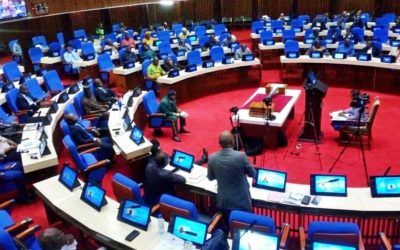
Sierra Leone’s constitutional amendment process has entered a new legal and political phase following the passage of the Constitution of Sierra Leone (Amendment) Act, 2025 in Parliament amid a walkout by lawmakers of the main opposition All People’s Congress (APC).
The controversy centres on whether Parliament validly passed the constitutional amendment after a vote in which 96 Members supported the measure, while 45 voted against it, and whether the procedure adopted by the Speaker complied with the constitutional requirement for altering the country’s supreme law.
The dispute has now moved beyond the floor of Parliament, with Speaker of Parliament Rt. Hon. Segepoh Solomon Thomas indicating that the Supreme Court will be asked to provide an opinion on the constitutional question surrounding the application of Section 91(1) in relation to Section 108 of the 1991 Constitution.
At the heart of the disagreement is the interpretation of the constitutional threshold required for amendments.
Section 108(2)(b) of the 1991 Constitution provides that a Bill seeking to alter the Constitution shall not be passed unless, at its second and third readings, it receives the support of not less than two-thirds of the Members of Parliament.
Parliament’s Standing Order 44(3) similarly refers to a requirement of not less than two-thirds of all Members of the House when dealing with a Bill seeking to alter the Constitution.
With Parliament consisting of 149 Members, two-thirds is 99.33. Applying the ordinary whole-number principle, that means 100 votes would be required to reach or exceed two-thirds of 149.
The opposition therefore argues that the 96 votes recorded in favour of the amendment were insufficient.
Minority Leader Hon. Abdul Kargbo challenged the procedure before the opposition MPs walked out of the chamber. He argued that the required constitutional threshold had not been reached and maintained that the APC could not participate in proceedings that, in its view, did not comply with the Constitution.
The walkout left only two opposition MPs, Hon. Mohamed Bangura and Hon. Alfred Ayodele Thompson, in the chamber to participate in the subsequent proceedings.
However, the Speaker adopted a different interpretation of the parliamentary procedure.
According to the material provided, Speaker Thomas ruled that the votes on the individual provisions of the Bill could be determined by a simple majority under Section 91(1) of the Constitution. That section establishes the general rule that, except where the Constitution provides otherwise, questions before Parliament are determined by a majority of Members present and voting.
This interpretation has become the central legal question.
The issue is whether Section 91(1), which establishes the general voting rule for parliamentary business, can govern votes taken during the consideration of a constitutional amendment Bill when Section 108 establishes a specific two-thirds requirement for constitutional alteration.
The Speaker’s decision has therefore raised a broader constitutional question: where the Constitution contains both a general parliamentary voting rule and a specific constitutional amendment procedure, which provision takes precedence in determining the validity of the vote?
The Speaker has acknowledged the seriousness of the question and referred the issue to the Supreme Court for an opinion.
In his ruling, Speaker Thomas stated that the question of whether a non-entrenched constitutional provision can be altered through recourse only to Section 91(1) is of grave public interest. He consequently referred the question to the Supreme Court for an opinion to be communicated to Parliament within three months to guide future discussions on the matter.
The numerical dispute has become one of the most important aspects of the controversy.
The parliamentary record cited in the material states that 96 votes were recorded in favour and 45 against the proposed constitutional alteration.
The opposition’s position is straightforward: if the constitutional requirement is two-thirds of the 149-member Parliament, then 96 votes cannot satisfy the threshold.
The difficulty, however, lies in determining what the Constitution means by “two-thirds of the Members of Parliament”.
Does the phrase refer to two-thirds of the full composition of Parliament?
Does it refer only to Members who are legally and validly existing at the time of the vote?
Or does it allow the calculation to be based on Members actually participating in the proceedings?
Those questions are particularly significant because Parliament has previously dealt with situations involving vacancies and absent Members.
The material notes that when the Sixth Parliament elected its Speaker in July 2023, the Clerk informed the House that Parliament had a composition of 149 Members and calculated two-thirds as 99. The parliamentary record indicated that the first three ballots required at least 99 votes.
However, Parliament later acknowledged that two seats were vacant following the death of Paramount Chief Victor Brima Sidi Kebbie and the serious illness of Paramount Chief Fabah Foday Kpakra. Despite those circumstances, the institution continued to describe the Sixth Parliament as comprising 149 Members.
That history creates another constitutional question: whether “Members of Parliament” refers to the prescribed numerical composition of the House, the Members legally and validly existing at the time, or those participating in a particular vote.
Section 30 of the Constitution is also relevant to the debate.
The provision states that, in determining a majority of all Members of Parliament, account should be taken only of persons actually and validly existing as Members at the relevant time.
That provision could have implications for how vacancies are treated when calculating parliamentary thresholds.
But the source material cautions against automatically applying Section 30 to every two-thirds calculation under Section 108.
Section 108 establishes a special procedure for constitutional alteration, while Standing Order 44 provides specific parliamentary rules concerning constitutional amendments.
The result is a complicated constitutional question involving several provisions that must be read together rather than in isolation.
One of the strongest arguments in the debate is that Parliament must remain capable of functioning even when some Members are absent.
A parliamentary boycott, according to that argument, should not automatically prevent Parliament from conducting its constitutional responsibilities.
Members who disagree with a parliamentary decision have constitutional and legal avenues through which they can challenge the interpretation adopted by Parliament.
But opponents of that position argue that constitutional amendments are fundamentally different from ordinary parliamentary business.
A quorum determines whether Parliament is sufficiently constituted to conduct business. A supermajority, by contrast, determines the level of support required for a particular decision.
Changing the Constitution is not the same as passing ordinary legislation because constitutional amendments change the legal framework under which political power itself operates.
The source material therefore raises an important concern: if a constitutional supermajority becomes easier to achieve whenever Members are absent, could constitutional safeguards become weaker precisely when political participation is reduced?
Previous parliamentary votes provide evidence of how heightened voting thresholds have been understood, although they do not necessarily settle the present dispute.
In December 2024, Parliament recorded a vote involving 137 Members in which 100 voted in favour, 36 against and one vote was declared void.
Parliament described the result as an “over Two-Thirds Majority Votes.”
However, the record does not conclusively establish the denominator used to calculate the two-thirds threshold. Consequently, that vote cannot by itself establish that two-thirds always means two-thirds of Members present.
The Constitutional Review Committee’s proposed constitutional text also provides an important clue.
The Committee proposed wording Section 108(2)(b) to expressly refer to “two thirds of all Members of Parliament.”
That proposal is not part of the existing law and therefore cannot determine the legality of the current amendment.
Nevertheless, it demonstrates that the constitutional review process considered the wording capable of being made more explicit.
The controversy is not limited to parliamentary procedure.
The amendment legislation proposes changes to constitutional provisions, including provisions concerning the electoral system and presidential elections.
Some of the provisions affected may fall within the category of entrenched provisions protected under Section 108(3), for which parliamentary approval can be followed by a national referendum.
This means that even though Parliament has passed the amendment legislation, questions surrounding the constitutional process and the status of particular amendments may continue to generate legal and political debate.
The parliamentary sitting was subsequently adjourned until 29 October, while the constitutional dispute remains unresolved.
What happens if the Supreme Court disagrees with the Speaker?
Perhaps the most consequential question arising from the dispute is what would happen if the Supreme Court ultimately reaches a different interpretation from the Speaker.
The controversy has raised questions about the relationship between Parliament and the Judiciary, particularly concerning the Speaker’s authority over parliamentary proceedings and the Supreme Court’s constitutional mandate.
The Speaker’s ruling is an exercise of parliamentary authority, but the Constitution itself establishes the Judiciary’s role in determining constitutional questions.
The source material therefore argues that the Supreme Court’s intervention could provide clarity on the meaning of “Members of Parliament” under Section 108, the relevance of Section 30, the relationship between constitutional provisions and Standing Order 44, and the effect of vacancies or changes in parliamentary membership on the two-thirds calculation.
Such an interpretation would potentially have consequences beyond the current amendment.
A definitive ruling could establish a standard for future constitutional amendments regardless of which political party controls Parliament.
That is particularly important in a democracy where parliamentary majorities change over time.
Today’s governing party could become tomorrow’s opposition, while today’s opposition could eventually control the majority.
For that reason, the constitutional rule must be capable of being applied consistently irrespective of political circumstances.
A test for constitutional governance
The dispute has consequently developed into more than a disagreement between the SLPP majority and APC opposition.
It is now a test of how Sierra Leone interprets and protects its Constitution.
Supporters of the parliamentary position can argue that Parliament must remain functional and that Members should not be able to frustrate constitutional business simply by refusing to participate.
Those challenging the process can argue that constitutional safeguards must not be weakened by absence and that a requirement for a two-thirds majority must have a clear and consistent meaning.
Both positions raise legitimate constitutional questions.
The ultimate issue is therefore not simply whether 96 Members voted in favour of the amendment.
It is whether those 96 votes satisfy the constitutional requirement applicable to the particular stage and nature of the amendment process.
The material puts the question plainly: “The constitutional question is whether those 96 votes satisfy the law, not whether they satisfy the politics of the moment.”
That distinction will be crucial if the matter reaches substantive consideration before the Supreme Court.
Sierra Leone now faces a constitutional moment in which political calculations, parliamentary procedure and judicial interpretation have converged.
The country does not merely need an answer for the amendment currently before Parliament. It needs clarity that can survive future changes in government and parliamentary majorities.
At stake is the interpretation of the rules by which the Constitution itself can be changed.
And ultimately, the question is not whether the Government or Opposition wins the political argument.
The question is whether the process used to amend Sierra Leone’s supreme law meets the requirements of the Constitution.